Tourism and Economic Development
Lecture 7
|
| |
Define Development
|
|
1.
Development
- considered good or progressive
- Old definition - real GDP per capita is increasing
- On average, incomes for the population are increasing
- New definition
- Economic
- real GDP per capita is increasing
- Income distribution is narrowing
- Social
- An improvement in health, education, employment opportunities, and housing
- Political
- Human rights
- Political freedom
- Cultural - protection or affirmation of a cultural identity
- Environmental Sustainability - ensure that resources used today are also available to the future generations
2. Characteristics of underdevelopment
- Large portion of population is in poverty
- Low GDP per capita
- Low living standard
- Gap between developed countries and undeveloped countries are widening
- Economiy is not diversified
- A country depends on a few industries
- Large portion of labor force usually 60% works in agricultural and fishing industries
- Poor health
- Developed countries have low life expectancies
- Age 74 for developed countries
- Age 62 for developing countries
- Age 51 for less developed countries
- High infant mortality rates
- Education - high illiteracy rates
- High rates of population growth
- High birth rates
- Abundance of labor
- High unemployment rates
- High underemployment rates
- Balance of payments problems
- High external foreign debts
- Countries import more than exports, causing an outflow of money from a country
3. Theories of Development
-
Modernization
- a country goes through a cycle
- Country begins as an agricultural society
- Country adopts manufacturing
- Incomes and wealth increase
- Financial institutions arise and become important
- New institutions may oppose traditional institutions, like the family
- Usually high savings rate is important, because it drives investment and modernization
- Problem - United States, and Europe is considered modern, and thus other countries want to emulate them
- United States and Europe impose their beliefs on other countries
-
Dependency Theory
- developing countries are dependent on the developed countries
- Marxists support this argument
- North countries – north of equator are rich and capitalistic
- South countries – south of the equator are poor
- Three eras
- Colonial dependence – many south countries were colonies 1500s to 1800s
- Exported raw materials, food, and resources
- Vulnerable to volatility in the international markets
- Imported manufactured goods
- Creates a trade imbalance because manufactured goods have a higher value
- Money flows out of colony
- Keeps colonies in poverty
- Financial-industrial dependence 19th and 20th centuries
- Manufactured products made in the North
- Current
- Multinational corporations dominate international trade
- Corporations are based in North countries
- Have financial power
- Profits are transferred out of South Countries
- Circumvent regulations in South Countries
|
Using Tourism for Economic Development
|
|
1. Tourism depends on open, free societies
- Example
- Turkey lowered legal restrictions for tourists to enter country
- Other countries follow suit to encourage tourists to come to their country
- Countries do impose bureaucratic requirements
- Visas for Americans, Canadians, and Europeans are relatively easy to come by or not required
- Kazakhstan requires an invitation letter from a tourist agency within Kazakhstan for tourist
- A Kazakh Embassy will not issue a visa without an invitation for a tourist
- Note - September 11, 2001 and heightened national security
- United States and European countries imposed new restrictions on travel, visas, etc. that hinders tourism
2. Tourism for growth
- The number of international tourists continue to grow
- Refer to the Table
| Year |
Arrivals
(1,000s) |
Receipts
($ millions)
|
| 1950 |
25,282 |
2,100 |
| 1960 |
69,320 |
6,867 |
| 1965 |
112,863 |
11,604 |
| 1970 |
165,787 |
17,900 |
| 1975 |
222,290 |
40,702 |
| 1980 |
285,997 |
105,320 |
| 1985 |
327,188 |
118,084 |
| 1990 |
458,229 |
268,928 |
| 1995 |
565,495 |
405,110 |
| 1998 |
625,236 |
444,741 |
- Tourism is sensitive to external events
- OPEC oil crisis in early 1970s
- Tourism declined to Middle East for the U.S. Gulf Wars in 1991 and 2001
- International tourists are predominately from industrialized countries
- Most flows are between industrialized countries
- Developed countries do not rely on tourism for growth
- Less flow from developed countries to less developed
-
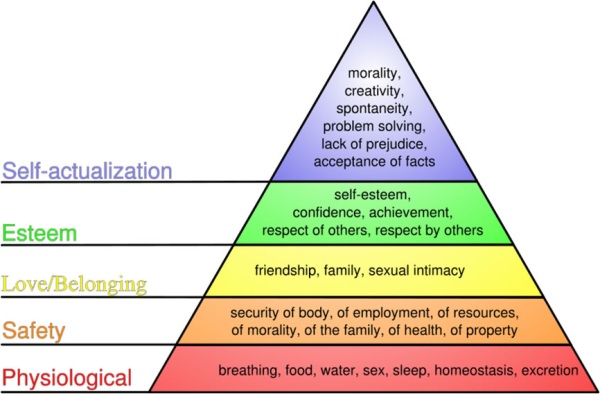
Maslow's Pyramid
- basic needs have to be met before a person scales up to higher level needs
- Tourism is a higher level need
- Developed countries have tourists with money
3. Difficult to measure impact of tourism on employment
-
Direct employment
- most researchers focus on this
- Hotels
- Restaurants
- Tour companies
- Night clubs
-
Indirect employment
- tourists and locals employed in tourism use these services
- Construction
- Professionals like doctors and lawyers
- Merchants
- Gas stations
-
Induced employment
- additional employment resulting from tourism multiplier
- Skills of local community has influence of type of employment created
- Some products are labor intensive
- Other products are capital intensive
-
Backward linkages
- supply chain to support tourist industry
- Tourists create a demand for
- accommodations
- food / beverages
- transportation
- souvenirs
- entertainment
- Could expand demand for local industries to supply tourists industry
- Farms
- Construction
- Manufacturing
- Cause infrastructure improvements
- Note - undeveloped countries may import a large share of goods / services needed by tourists
4. Developed countries
- Tourism is
- Seasonal
- Low pay
- High turnover rate
- Menial work
- Low status
- Alternative employment has better pay
- Most tourism industry is privately held
- Highly competitive
- Market approach
- Local government and local businesses promote tourism
- National government is usually not involved in tourism industry
|
Developing Countries and Tourism for Economic Development
|
|
Developing countries use tourism as a source of growth and development
1. Benefits
- Help diversify economy
- Example - Gambia is a small poor African country
- Relies on the export of nuts
- Diversified its economy by adding tourism
- Economic development
- Develop rural areas and/or islands
- Offset declines in manufacturing
- Encourage urban revitalization
- Reduce dependence on foreign aid
- Country has little natural resources
- People have a low savings rate (less investment)
- Lack of export opportunities
- Tourism is a source of foreign currencies
- Reduce trade deficits
- Create income and employment opportunities for local population
- Tourism jobs are seasonal or part-time jobs
- Still reduces unemployment levels
- Local staff may have multiple jobs
- Local staff may have more than one occupation
- Wages may be high enough to last through the low season
- Tourism creates opportunities for students and women
- Labor intensive industry
- Demand for unskilled workers or semi-skilled workers
- Increase standard of living
- Tourist industry pays relatively higher than agriculture and fishing industries
- Employment is looked upon favorably by local population
- Example - Cyprus has about 25% of population employed in tourist industry
- Formal schools to train for tourist industry
- Social
- A better understanding between different civilizations
- Introduce local traditions to the world
2. Problems
- Social
- Damages family structures
- Creates subsistence food production
- Displaces local people, as government and businesses construct new airports, resorts, nature reserves, and attraction sites
- Encourages behaviors, such as begging, and harassment of visitors.
- Encourages urbanization and emigration to tourist site
- Could create friction and resentment between local people and visitors
- Causes overcrowding
- Increased cost of living for residents
- Residents may not have access to recreational areas and facilities
- Increased traffic and congestion
- Increase in health risks through diseases such as AIDS, malaria, hepatitis, and influenza.
- Increase in crime
- Crimes against visitors
- Increase in drug abuse and prostitution
- Decrease in public morality
- Cultural
- Commercialization of traditional customs in order to make profit
- Loss of cultural identity
- Creates misunderstanding between visitors & local community
- Negative impact on cultural and natural heritage resources
- Damage to archaeological and historical sites and monuments
- Employment
- Seasonal - job and income insecurity
- Usually has high turnover rate
- Lack of union power
- Lack of training
- Lack of medical benefits
- Unsatisfactory housing and working conditions
- No guarantee of employment from season to season
- High leakage of tourist revenue from imported goods and services
- 80% of travellers' expenditures goes to the airlines, hotels and other international companies
- Visitors prefer to travel using an airline from their country of origin rather than the airline of the destination country
- Local businesses and workers are excluded from most tourist activity
- Corporations especially in the hotel industry dominate
- Corporations are usually from developed countries
- Profits flow back to the home, developed country
- Generate lower foreign exchange earnings than local hotels
- High managerial positions go to expatriates
- Portions of their salaries go back to their home countries
- Developing countries have higher leakage than developed countries
- Thailand - approximately 70% of all money spent by tourists leaves Thailand
- Caribbean is approximately 80%
- India is approximately 40%
- Small developing countries range from 40% to 50%
- Developed economies range from 10% to 20%
- Note - if locals owned more tourists businesses, such as hotels, more money stays inside of country
- Local businesses are more likely to buy from local suppliers
3. Investment for Developing Countries
- Benefits for developing country
- It is investment
- Brings technology
- Quality improves
- Products and services become cheaper
- Real wages can increase
- Increases tax revenue
- Fosters an awareness of a market economy
- Problems for developing country
- Local companies are not able to compete with foreign companies
- International companies may have vertical and horizontal integration; thus, foreign companies may have market power
- Local companies may lack the know-how or technology
- Investment costs may increase, again putting local companies at a disadvantage
- Foreign companies hire expatriates, especially for high-level and technical positions
- Foreign companies import machines/equipment, etc.
- Foreign companies may change tourists' tastes, importing more goods and services
- Foreign companies transfer their profits back to their home country
4. Developing countries usually have a large
informal sector
- Informal sector has the characteristics
- Economic activity is usually not included in GDP
- Government does not regulate
- Workers in informal economy are usually self-employed
- Workers may not pay income or social security taxes
- Although the activity may be legal, violators are not paying taxes or following regulations
- Easily 40 to 50% of labor force may wotk in the informal sector
- Ease of entry
- Reliance of indigenous resources
- Family ownership of enterprise
- Small scale of operation
- Labor intensive
- Skills acquired from outside of formal schooling
- Symbiotic relationship between formal and informal sectors
- Informal depends on formal for supplies in certain inputs
- Formal depends on informal for low-cost labor, and low-cost products and services
- Wages may be higher in informal than formal sector
- Informal workers are exposed to foreign lifestyles, languages, and materialism
- They emulate the tourists
- Gain more skills or more education
- Speak one or more foreign languages
- Gain marketing techniques
- Learn to fix or maintain equipment
- Become tour guides - considered good pay and status
- Women work informal sector
- Flexible hours
- Return home when kids return from school
- Bring young children with them
|
Government Involvement into Tourism
|
|
1. Government involvement in tourism
- High-level government intervention in tourist industry
- Optimize return to tourism industry
- Prevent exploitation and waste
- Increased tax base
- Government has many costs in order to use tourism for economic development
- Improve infrastructure and facilities
- sea
- beaches
- mountains
- historic sites or ruins
- Protect the environmental, natural and cultural resources
- Subsidize education and training
- Establishes regulatory agencies and laws
- Establish a pro-business environment to encourage investment from private companies and businesses
- Governments play a necessary role in development
- Private sector may not have the size and capital to development a destination
- Government may be the lead developer, and controls the development
- Governments support certain industries to create jobs, and tax revenue
- Government controls zoning laws and building safety codes
- Invests in infrastructure
- Airports, and transportation hubs
- Water and sewage systems
- Roads
- Electricity
- Telephone networks
- National parks
- Improves quality of life for residents
- Government regulation protects tourists and enhances their travel experiences
- Consumer protection laws and rules
- Fire safety laws in hotels
- Health and food safety regulations
- Licensing of persons and businesses, such as tour operators, travel agencies, hotels, restaurants, and others
- Environmental protection regulations
- International aviation and air travel regulation
- Tourism development has high opportunity costs
- Government pays infrastructure costs
- Government markets the the country and tourist destination
- Developers may want tax breaks and tax credits to invest at tourist destination
- Government may reduce programs for its citizens, such as education and health
- Government controls and monitors the border
- Entry and exit
- Issues visas
- Enforce custom regulations
2.
Political stability
- influence the image of destinations at tourist sites
- A tourist may not visit, if a destination has turmoil or unrest
- Books, magazines, newspapers, satellite and cable links substantially influence tourists
- A tourist may not visit the destination, if there are wars, coups political strikes, or protests
- Example 1: Yugoslavia
- Yugoslavian (Serbian) Army attacks Slovenia in 1991
- Army attacked Croatia in 1991
- Army attack Bosnia-Herzegovina in 1992
- Tour operators for Yugoslavia lost over one million bookings in 1991
- Two years after the war, Slovenian tourism was still below pre-war figures
- Example 2: Peru
- The Maoist Terrorist Group Aim attacked the Peruvian government
- Attacks caused tourism to drop from 350,000 international visitors in 1989 to 33,000 in 1991
3. Tourism as a Political Tool
- Government uses tourism to convey a positive image
- Example: Re-election of Marcos in Philippines
- Used tourist arrivals to legitimize his regime
- Bombing attempt on Marcos at 1980
- Caused a dramatic reduction in tourist visitation from the USA
- Western governments issue regular travel advisories for their citizens
- Warns risks in travelling to certain destinations
- Tourists usually adhere to warnings, and avoid countries with warning advisories
- Governments use political pressure to promote or sanction specific countries
|
Tourist Industry in Bali, Indonesia
|
|
Characteristics of tourism industry in Bali, Indonesia
- Bali has a thriving tourist industry
- Some parts of Indonesia is extremely poor
- Salaries for crafts people are higher than local farmers and peasants
- Most of the population has only a primary education
- Workers in informal sector earn more than the minimum wage
- Not marginalized
- Independent
- Entrepreneurial
- Not dominated by formal sector
- Speak one or more foreign languages
- Many guides and vendors do not obtain required gov. licenses
- Males usually migrate from the poor island, Java, to Bali
- Migrants take vending jobs
- Balinese consider vending jobs as a low status
- Migrants fill a niche
- Women earning salaries
- Has conflict with husband and/or parents
- Mexico - more female head of households in tourist destination
-
Caste system
is challenged in Bali
- Caste hierarchy
- Poor - majority of population
- Priests
- Merchants
- Nobles
- Caste is being replaced by an economic class system
- Hotel employee - highest
- Guides
- Owning a kiosk or other tourist business
|
Terminology
|
- development
- modernization
- Dependency Theory
- Maslow's Pyramid
- direct employment
- indirect employment
|
- induced employment
- backward linkages
- informal sector
- political stability
- caste system
|
|