The Foreign Exchange Market
Lecture 12
|
| |
Foreign Exchange Market
|
- Foreign exchange market - the currency of one country is traded for another currency
- Who uses foreign currencies?
- International banks - transfers billions in foreign currencies with other banks
- Businesses, especially involved in imports and exports
- International investors
- Hedge - invest in a variety of countries to reduce risk
- Speculation - buy currency for a low price and sell for high price
- Arbitrage - an investors sees a price difference of same currency in two markets, he buys currency for a low price and sells to the high price market
- Price differences disappear
- Tourists
- Central banks and government – manipulate exchange rates
- Characteristics
- Most transactions are electronic transfers
- Largest market
- $3.2 trillion per day in 2007
- Trade occurs 24 hours per day, 7 days per week
- Spot market – the exchange of currencies occur immediately between buyers and sellers
- Retail - small agents buy and sell foreign currencies
- Two exchange rates
- Selling price is always higher than buying price
- The price spread is commission
- Wholesale - network of about 2,000 banks and brokerage firms
- International clearing system - exchange of electronic deposits
- Similar to a clearing house for checks
- Derivatives – contracts involving the exchange of currencies in the future
|
Exchange Rates
|
- Cross Rate - calculate the exchange rate for currencies that are rarely traded
- Example 1
- Pesos to U.S. dollars: pesos 11.43 / $1
- Euros to U.S. dollars: € 0.6944 / $1
- Trick - keep currency units; correct calculation has units fall out
- Calculate pesos to euros: ps 11.43 / $ divided by € 0.6944 / $ = ps 16.46 / 1 €
- Example 2
- KM to euros: KM 2 / 1 €
- Euros to U.S. dollars: € 0.714 / 1$
- $12 trillion per day in 2004
- Calculate KM to U.S. dollars: (KM 2 / €)($1 /€ 0.714) = KM 1.428 / $1
- Intermarket Arbitrage - profit from price differences
- Example 1
- Trader at Citibank has $100,000
- Citibank $1.54 / 1 pound
- National Westminster € 1.6 / 1 pound
- Deutsche Bank $0.97 / 1 €
- Calculate the cross rate = ($1.54 / 1 pound) / (€ 1.6 / 1 pound) = $0.9625 / 1 €
- Arbitrage exists
- Step 1 - Convert dollars to pounds at Citibank: $100,000 / ($1.54 / pound) = 64,935.06 pounds
- Step 2 - Convert pounds to €s at National Westminster: (64,935.06 pounds)(€ 1.6 / 1 pound) = 103,896.10 €
- Step 3 - Convert €s to dollars at Deutsche: (1,038,961.04 €)($0.97 / 1 €) = $100,779.22
- The gain is $779.22
- Example 2
- Trader at Citibank has 500,000 €
- Citibank KM 2 / 1 €
- Unibank $0.67 / 1 KM
- Spark Bank $1.3 / 1 €
- Calculate the cross rate = (KM 2 / 1 €) / ($0.67 / 1 KM) = $1.34 / 1 €
- Arbitrage exists
- Step 1 - Convert €s to KM at Citibank: (500,000 €)(KM 2 / 1 €) = 1,000,000 KM
- Step 2 - Convert KM to $ at National Unibank: (1,000,000 KM)($ 0.67 / 1 KM) = $670,000
- Step 3 - Convert $ to € at Spark Bank: ($670,000) / ($1.3 / 1 €) = 515,384.61 €
- The gain is 15,0384.61 €
|
Demand and Supply for Currencies
|
- Use demand and supply functions
- Assumptions
- No government interference
- Flexible exchange rate
- Trade between Mexico and U.S.
- Exchange rate - the dollar price of 1 peso
- Import - U.S. residents and firms purchase goods and services from Mexico
- U.S. firms buy Mexican goods
- U.S. firm needs pesos to pay for it
- Demand for pesos increases
- Converting dollars to pesos causes supply of dollars to increase on foreign exchange market
- Export - U.S. residents and firm sell goods and services to Mexico.
- U.S. firms sell computers to Mexican firms.
- Mexican firms need dollars to pay for it.
- Demand for dollars increases.
- Converting pesos to dollars causes supply of pesos to increase
- Demand for currencies - Demand for pesos in one market creates a supply of U.S. dollars in other market, and vice-versa
| The Exchange Market for Pesos |
Price of pesos
($ for 1 peso)
Quantity of pesos
|
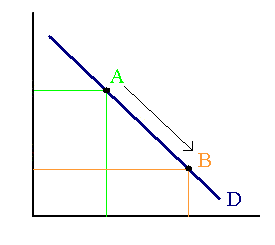
- Moving from Point A to Point B causes exchange rate to go down
- Point A : $ 1/10 per 1 peso [$1 = 10 pesos]
- Point B: $ 1/20 per 1 peso [$1 = 20 pesos]
- The $ appreciated, because $1 buys more pesos
- The peso depreciated, because 1 peso buys less dollars
- The price of U.S. goods became more expensive, while Mexican goods become cheaper
- U.S. imports increase
- U.S. exports decrease
- Terminology
- Appreciation - currency becomes more valuable; can buy more of another currency
- Depreciation - currency becomes less valuable; can buy less of another currency
- Strong - currency is relatively valuable against a basket of currencies
- Weak - currency is relatively less valuable against a basket of currencies
- Supply of currencies
| The Exchange Market for Pesos |
Price of pesos
($ per 1 peso)
Quantity of pesos
|
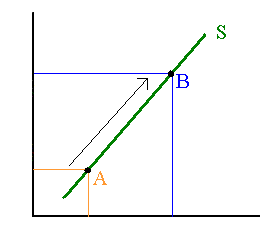
- Moving from Point A to Point B causes exchange rate to go up
- The $ depreciated in value
- The peso appreciated in value
- The price of U.S. goods became cheaper, while Mexican goods become more expensive
- U.S. imports decrease
- U.S. exports increase
Note - For Mexicans to buy more U.S. cheaper products, they need dollars. They convert pesos into dollars, causing more pesos to be supplied on the market.
|
Examples
|
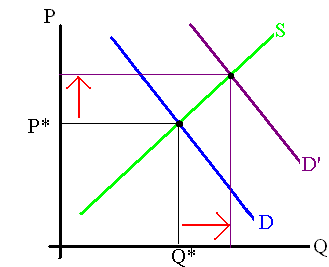
- Americans demand more Mexican products, ceteris paribus
| The Exchange Market for Pesos |
Price of pesos
($s per 1 peso)
Quantity of pesos
|
- The equilibrium exchange rate is at P* and quantity exchanged is Q*
- Demand for pesos increases
- The dollar depreciates, while peso appreciates
- U.S. products become cheaper to Mexicans
- U.S. exports rise
- U.S. imports decrease
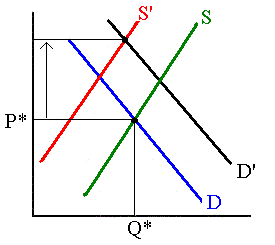
- The real interest rate is higher in Kazakhstan than the U.S.
| The Exchange Market for Pesos |
Price of tenge
($s per tenge)
Quantity of tenge
|
-
- Original market price and quantity are P* and Q*
- U.S. investors increase demand for tenge, wanting to earn higher interest rate
- Kazakh citizens invest more within their country, decreasing supply of tenge
- If two functions shift
- Quantity or price becomes indeterminate
- In this case, U.S. dollar depreciates, while tenge appreciates
- Quantity of tenge becomes indeterminate
- The inflation rate is higher in Mexico than the U.S.
| The Exchange Market for U.S. Dollars |
Price of U.S. dollars
(Pesos per $1 )
Quantity of U.S. dollars
|
-
- Original market price and quantity are P* and Q*
- Price of Mexican goods becomes expensive
- Price of U.S. goods become relatively cheaper
- Mexican increase demand for U.S. goods, increasing demand for dollars
- U.S. citizens buy more domestic goods, decreasing their demand for Mexican goods and hence a decrease in supply of dollars
- U.S. dollar appreciates while peso depreciates
- Federal Reserve System (U.S. central bank) increases dollars on international market; the Fed buys foreign currencies by using U.S. dollars. This increases the demand for foreign currencies.
| The Exchange Market for U.S. Dollars |
Price of U.S. dollars
(Tenge per $1)
Quantity of U.S. dollars
|
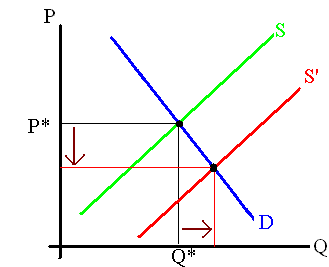
-
- U.S. dollars increase, increasing supply of dollars
- U.S. dollar depreciates while tenge appreciates
- Note – There are two markets for each example. The omitted market will have the supply or demand function shift in the opposite direction
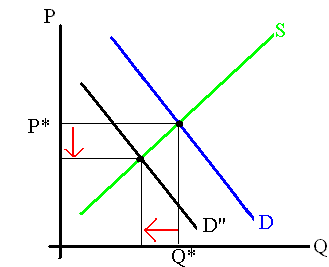
- Investors believe the U.S. dollar will depreciate.
| The Exchange Market for U.S. Dollars |
Price of U.S. dollars
(€ per $1)
Quantity of U.S. dollars
|
-
- Investors reduce their demand for U.S. dollars, causing the demand to shift left
- U.S. dollar depreciates while € appreciates. This becomes a self-fulfilling prophecy. The investors' beliefs turned into reality.
- The United States has faster productivity growth than Europe.
| The Exchange Market for U.S. Dollars |
Price of U.S. dollars
(€s per $1 )
Quantity of U.S. dollars
|
-
- Higher productivity causes U.S. products to become cheaper. Europeans buy more U.S. products because they are cheaper, causing the demand for U.S. dollars to increase and shift right.
- Americans buy less European goods. Thus, Americans have a lower demand for euros, which means less euros are converted into U.S. dollars. The supply of dollars decreases and shifts left.
- U.S. dollar appreciates while the euro depreciates. The quantity of dollars is indeterminate.
- The United States imposes tariffs on Mexican goods.
| The Exchange Market for Pesos |
Price of pesos
(U.S. dollars per peso)
Quantity of pesos
|
-
- Americans buy less Mexican products because they are more expensive. Thus, Americans reduce their demand for pesos, causing the demand to shift left
- U.S. dollar appreciates while the peso depreciates. This makes the U.S. export industries less competitive.
- Mexico could also impose tariffs on U.S. products.
|
Fixed Exchange Rates
|
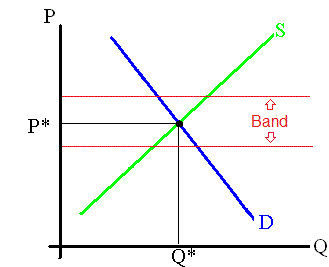
Fixed Exchange Rates – government enters market and fixes the exchange rate
- Also called pegged exchange rate
- Gov. or central bank requires a cache of currency reserves
- Gov. does not specify an exact price
- Gov. specifies a band
- Exchange rate is allowed to move within band
- If exchange rate falls outside of band, then gov. interferes in market to bring exchange rate back into the band
- Example – United Arab Emirates uses a fix exchange rate of $1 = 3 dirhams
| The Exchange Market for Dirhams |
Price of dirhams
($ per dirham)
Quantity of dirhams
|
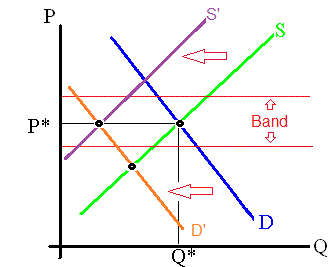
- Demand for the Dirham falls and price is outside of band
| The Exchange Market for Dirhams |
Price of dirhams
($ per dirham)
Quantity of dirhams
|
- The central bank has to buy Dirhams off the exchange market, causing the supply function to decrease
- The central bank needs to exchange Dirhams for a strong currency like U.S. dollars or euros
- Central bank requires a cache of reserves
- Terminology
- If the central bank allows the currency to appreciate permanently outside the band, it is called a revaluation.
- If the central bank allows the currency to depreciate permanently outside the band, it is a devaluation.
|