Mercantilism and Comparative Advantage
Lecture 3
|
| |
Mercantilism
|
Mercantilism – the oldest and most powerful
- Rise of the modern nations in Europe during 15th and 18th centuries
- Nations create wealth and power
- National security is a top priority
- Need strong military
- Europe fought many wars
- Differences
- Economics – International trade
- Everyone wins
- Positive sum game
- Free trade creates income and wealth for all participants
- Mercantilism – one gains while another loses
- Free trade is a myth
- Us versus them
- The goal is to capture income and wealth
- Mercantilism – state promotes exports and limits imports
- Creates trade surplus
- Causes inflow of money into country, i.e. gold and silver
- Could cause inflation
- Creates wealth and power
- Founded colonies
- Colonies shipped raw materials to mother country
- Mother country shipped manufactured products to colony
- Manufactured goods have higher value than raw materials, creating trade suplus for mother country
- Expand definition
- Nations finance industries
- Build roads and ports – employ workers
- Improve record keeping, navigation and shipping
- States imported skilled labor to build ships and ports
- Trade protection - financed by imposing taxes on imports
- Who benefits?
- King used the gold to build a strong military
- Military is expensive
- Wealth allows countries to buy weapons
- King granted licenses and permission to industry
- Allowed monopolies to form
- Allowed exporting firms to export products
- Businessmen paid the king for these rights
- Gov. bureaucrats – expand gov.
- Merchants and joint stock companies
- Does mercantilism work?
- Japan was devastated after WWII and became the second largest economy within one generation
- Asian tigers and China
- Price-specie-flow doctrine
- Large flow of money into economy causes inflation
- Higher prices reduce exports and increases imports
|
Absolute and Comparative Advantage
|
- Law of Absolute Advantage (Adam Smith)
- Countries specialize in production where they have low costs
- Book – uses labor productivity
- Labor productivity – amount of output each worker can produce in one hour
- Example
| Productivity |
U.S. |
|
China |
| Soybeans |
50 |
> |
20 |
| Laptops |
6 |
< |
10 |
-
- World gains from free trade
- U.S. produces soybeans, while China produces laptops
- Thus, the U.S. exports soybeans and imports laptops
- Free commerce makes nations efficient
- Encourage innovation
- Problem – What if a country has an absolute advantage in all trade?
- No incentive to trade
- U.S. has higher productivity than China
| Productivity |
U.S. |
|
China |
| Soybeans |
50 |
> |
20 |
| Laptops |
20 |
> |
10 |
- Law of Comparative Advantage (David Ricardo) - a country produces a product that has a relative cost advantage
- Countries with absolute advantage still have an incentive to trade
- Opportunity cost – to produce one more unit of soybeans, a country gives up production on laptops
- Industries shift resources, like labor, capital, materials, etc. from one industry to another
- Divide productivity of one product by the productivity of another
| Opportunity Costs |
U.S. |
China |
| Soybeans |
0.4 laptops per soybeans |
0.5 laptops per soybeans |
| Laptops |
2.5 soybeans per laptop |
2 soybeans per laptop |
-
- Numbers in table are relative prices
- No money; a country's exports equal its imports
- If no trade, then relative prices are prices for economy
- Both countries have many buyers and sellers; no market power
- Arbitrage – if prices differ between two markets, then traders will buy for low price and sell for high price
- No transaction cost
- No transportation cost
- No trade barriers
- Results
- U.S. should grow soybeans and sell them to China
- To grow one more unit of soybeans, the U.S. has to give up 0.4 laptop
- China gives up 0.5, which is greater
- U.S. has a lower opportunity cost than China
- China should produce laptops and sell them to the U.S.
- China has a lower opportunity costs than U.S.
- World price
- Price of soybeans would lie between 0.4 and 0.5
- Price of laptops would lie between 2 and 2.5
|
Production Possibilities Curve (PPC)
|
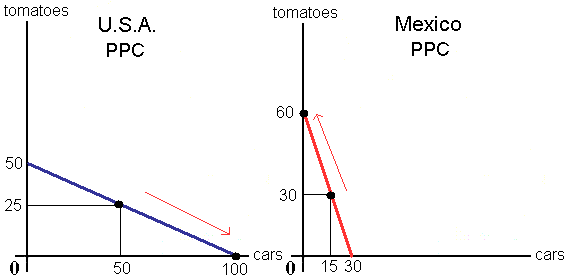
- Production Possibilities Curve (PPC) - shows country's production level given its level of resources
- Macroeconomics
- Country can produce two products given its resources
- Used to illustrate trade
- Example
- Mexico and United States
- Both produce tomatoes and cars
| Item |
U.S. |
Mexico |
| Cars (max) |
100 |
30 |
| Tomatoes (max) |
50 |
60 |
- Draw the PPCs
| The PPCs for the United States and Mexico |
|
-
- Comparative advantage
- Opportunity cost is slope of the line; also called the marginal rate of transformation (MRT)
| Item |
U.S. |
Mexico |
| Cars (max) |
0.5 tomatoes per car |
2 tomatoes per car |
| Tomatoes (max) |
2 cars per tomato |
0.5 cars per tomato |
-
- Note – straight line PPC means all resources are perfectly suited for both products
- All labor, capital, etc. are equally productive for both products
- Leads to complete specialization; country does not lose its comparative advantage
- United States specializes in cars while Mexico specializes in tomatoes
- Results
- Autarky - no free trade
- Set consumption at the half way point
- U.S. produces 50 cars and 25 tomatoes
- Mexico produces 15 cars and 30 tomatoes
- Total production is 55 cars and 55 tomatoes
- Free trade - complete specialization
- U.S. produces 100 cars and no tomatoes
- Mexico produces 60 tomatoes
- Total production is 100 cars and 60 tomatoes
- Consumption lies outside the boundary of the PPC
- Cannot answer how this production is divided up
- Theory of Reciprocal Demand - if one country is larger (i.e. has more consumers), then the terms of trade will be closer to the larger country
- U.S. is larger than Mexico, then U.S. may get more of the production from trade
- Assumes trade flows are balanced; no trade surpluses or deficits
|
North-South Dilemma
|
- Less-Developed Countries (LDCs) tend to be located south of equator
- Developed rich countries are located in the north
- Author – “south” has lower productivity, which translates into lower wages
- Productivity – the more output a worker can produce means he can earn a higher wage
- Dependency Theory – LCDs are dependent on the North America-European countries
- Exported raw materials, food, and resources
- Resources and raw material prices are volatility in the international markets
- Imported manufactured goods
- Creates a trade imbalance because manufactured goods have a higher value
- Money flows out of LDCs
- Keeps them in poverty
- LDCs cannot get access to technology
- Tight legal controls on patents, copyrights, and licensing from Western countries
- LDCs cannot gain a competitive edge
|